
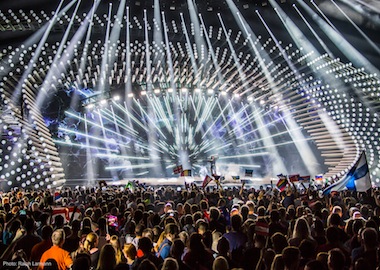
Award-winning
lighting designer Al Gurdon made spectacular use of a predominantly Clay Paky
rig for one of the world’s largest TV entertainment events, The Eurovision Song
Contest 2015
Celebrating
its 60th anniversary with the theme, ‘Building Bridges, Eurovision was
sponsored by OSRAM and hosted at the Wiener Stadthalle in Vienna.
UK based
Gurdon, whose previous lighting triumphs include the opening and closing
ceremonies of the Sochi Olympic Games and the American Super Bowl, has now lit
Eurovision three times. This time he chose 172 of the new Clay Paky Mythos, 48
X Sharpy Wash 330, 83 X A.leda B-EYE K20 and 74 Stormy fixtures to deliver a
dazzling, party atmosphere bursting with vibrant colour, varying shape and
dimension.
All
equipment was supplied by Production Resource Group (PRG), supplemented by Clay
Paky UK distributor Ambersphere, and supported by a team of specialist
technicians led by Lighting Crew Chief, Richard Gorrod.
Working alongside Eurovision’s
creative director, Kurt Pongratz, Gurdon and his programmer Mike Owen delivered a sharp, beat perfect
lighting design that complemented each act’s stunning video content, which was
conveyed via the floor, the backdrop screen of the stage and across the end lit
array of aluminium pipes, which made up the eye shaped set.
With almost
40 different nations taking part, each demanding its own defining look, Gurdon
had his work cut out: “The challenge for us was to guarantee each nation’s song
felt unique,” explains Gurdon. “At the same time we had to deliver a cohesive
feel to the overall look of the broadcast. Because of this I wanted to ensure
the backbone of my lighting rig was consistent.”
Gurdon
needed a fixture that was bright, punchy and versatile: “Ultimately I chose the
Mythos because it offered everything I was looking for. It performs just as
well as a beam light as it does as a spotlight. The color mixing facility was
also a crucial decider because it allows me to fine tune and color match to all
the other mediums being used on stage.”
Designed
specifically for television, Eurovision presents a number of its own unique
challenges. Pulling performers out from a video heavy backdrop, conveyed on a
2D medium, while keeping color and intensity balanced across all the output
mediums can be testing.
Bringing
additional visual depth to the lively stage and some stunning beam effects,
Gurdon designed a matrix of Clay Paky A.leda B-EYE K20s. These were rigged in
such a way as to evoke one giant B-EYE and the whole matrix could migrate from
behind the main video backdrop to above the screen, offering a number of different
effects and looks.
“For some of
the performances we would remove the rear video screen and use the B-EYE matrix
as a dynamic, high impact backdrop or beam effect generator. We could also move
it overhead to shine down and twinkle through the array of end lit pipes that
framed the stage,” explains Gurdon. “This was extremely effective, especially
for Ireland’s forest scene. The fixtures allowed us to generate a look that
felt organic from something very high-tech. They also brought a great dynamic into
the room and could be used to extend the height of the set, such as during
Italy’s big operatic number.”
Further
supporting the Mythos, Gurdon rigged numerous Sharpy Wash 330s towards the back
of the set. PRG Lighting Crew Chief Richard Gorrod explains: “The power of
Sharpy Wash 330 fixtures complemented the Mythos and at the same time, their
compact size proved ideal for the venue, as it has quite a low roof.”
Adding
further dimension and for those moments requiring additional ooomph Gurdon
peppered his rig with a number of Clay Paky Stormy CCs, which delivered intense strobing and super bright swathes of
colour across the back of the stage. “Clay Paky fixtures have definitely become
the standard in stage and TV lighting,” says Gorrod. “The looks they can
achieve and the fact that they are robust and reliable make them a great rental
investment – you hang them up and they work. Plus, they’re relatively
lightweight and use remarkably little power for their resulting output. The
Mythos is just 470W. This means that, compared to prior Eurovision events, the
power consumption on this year’s contest has been significantly reduced.”
Every year
some 180 million viewers watch the Eurovision Song Contest. This year Sweden
was victorious, with its entry ‘Heroes’ by Måns Zelmerlöw.
Photos: Ralph Larmann


